


Knife Master: Challenge Game
4.915.00 Reviews
App Specs
- Version
- 2.0.22
- Updated On
- License
- Free
- Downloads
- 10,000+
- Developer
- Blastproof Games
- Categories
- Arcade
- Platform
- Android
Screenshots



 Analysis by AppCompare
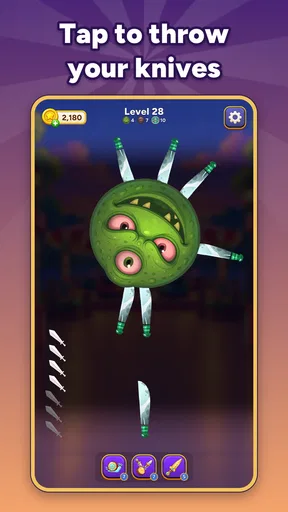
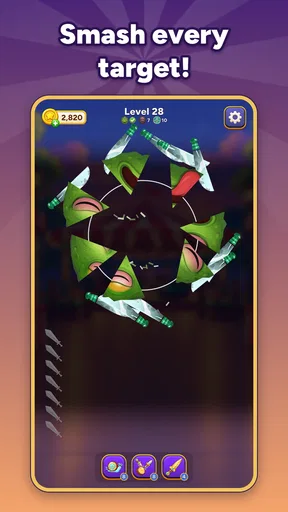
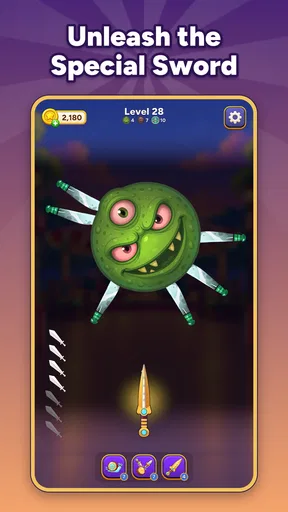
I went into Knife Master: Challenge Game expecting a quick arcade distraction, and that is exactly where it works best. Its central idea is easy to understand: throw knives at rotating logs, break them apart, and work toward boss encounters. The appeal is not a complicated story or a large collection of systems. It is the immediate challenge of judging timing, spacing, and patience one throw at a time.
That focused design gives the game a clear identity. Instead of asking me to learn a broad control scheme, it puts nearly all of its attention on a single action and the decisions surrounding it. I found that useful when I wanted something I could start quickly, play in short bursts, and stop without losing track of a long campaign. At the same time, the narrow format means it will not suit people looking for a deep arcade package with many different modes.
Why the knife-throwing challenge works
The strongest capability here is the way one simple gesture becomes a test of rhythm. Throwing a knife sounds straightforward, but the rotating target makes every attempt depend on the moment I choose. A throw that looks safe can become a mistake if I act too quickly, while waiting too long can make the next opening harder to read. That small gap between seeing an opportunity and committing to it creates the tension.
I particularly like that the game’s basic objective is readable without explanation. The store summary points to knives, logs, and bosses, and those elements give the experience its shape without burying the player in instructions. I can understand what I am trying to do almost immediately, then spend my attention improving my timing rather than decoding menus or objectives.
The best way to think about it is as a compact precision arcade game. It rewards controlled reactions more than frantic tapping. When I treated each throw as a separate decision, the challenge felt fairer and more satisfying. When I rushed because I wanted to finish a section quickly, the same simplicity exposed my impatience.
The real hook is not throwing faster; it is learning when not to throw. That distinction matters because it separates a tense attempt from random swiping. The game can give a short session a surprisingly active mental rhythm, even though the visible action remains minimal.
Reading the target instead of chasing speed
My most useful adjustment was to watch the open spaces on the log before focusing on the knife itself. The target’s movement gives me a visual pattern, and concentrating on that pattern makes the next decision easier. I also found it better to keep a steady pace rather than changing from extremely cautious to extremely hurried after one successful throw.
Worth Reading Before You Choose

Switching to Android Auto Means Rethinking Your Driving Routine

Google Calendar Makes a Crowded Week Easier to Manage

Baby Panda World Brings Quick Play to Modern Phones, but Its Game Library Feels Busy

ESPN’s Live Game View Makes Following Close Games Easier

QuizzLand Review: A Good Fit for Short Trivia Breaks, Not Every Player

Basketball Stars: Multiplayer Is Fast, but Can It Recover When Matches Go Wrong?
This approach is especially helpful around the more demanding moments. Bosses provide a natural reason to slow down and reassess instead of assuming that the same timing will work forever. I would not describe the game as a reflex test alone. It also asks whether I can maintain attention after a few successful actions, when overconfidence becomes the bigger danger.
For new players, I recommend treating early attempts as practice in observation. Do not measure success only by how quickly a log breaks. Notice which visual openings you tend to miss and whether your errors come from acting early, acting late, or losing concentration. That small habit makes the challenge feel less random and gives each retry a purpose.
How it feels in everyday play
In practice, this is the kind of arcade game I can use between larger tasks. A realistic example would be waiting for a bus or taking a short break after finishing a message. I can open it, make a few attempts, and put it down without needing to remember a complicated plot or rebuild a large setup. That makes the game more convenient than a longer action title when I only have a few spare minutes.
The same short-session strength can also become a limitation. If I am hoping for a substantial progression system, character development, or a variety of arcade activities, the knife-and-log format may begin to feel narrow. The game’s satisfaction comes from refining the same central skill, not from constantly introducing a new type of play.
I would also avoid approaching it as a background game. The controls may be simple, but the timing still deserves attention. Playing while distracted makes mistakes feel more frustrating because I know I failed to read the opening rather than being challenged by a complex control scheme. It is casual in presentation, yet it still benefits from a quiet moment of concentration.
One practical technique is to use a consistent visual anchor. I found it easier to judge the next throw by following the target’s movement and selecting a gap, rather than staring at the knife already in flight. This reduces the temptation to react emotionally to the previous result. A missed throw should change my timing, not send me into a burst of hurried attempts.
Another useful habit is to pause mentally after a successful sequence. Progress can create a false sense that the next opening will be identical. Boss sections are a good reminder that familiar timing may need adjustment. Even without adding complicated rules to the experience, the game encourages me to reset my expectations when the situation changes.
What the boss encounters add
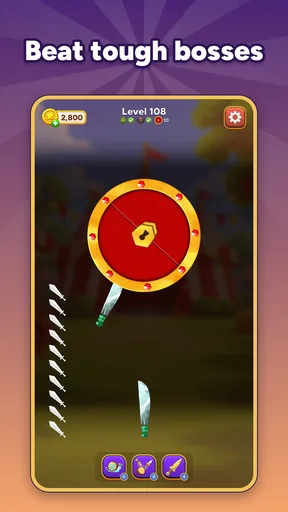
The boss idea gives the simple loop a sense of direction. Without those encounters, throwing knives at logs could feel like an endless exercise with no meaningful peaks. Bosses suggest moments where the player must bring together the patience and timing learned during ordinary attempts. They serve as checkpoints for skill, even for someone who is playing casually.
I would not buy this game solely for boss battles, because the main activity remains the heart of the experience. Their value is that they interrupt the routine and give me a reason to take the next section seriously. They also make failure more memorable: losing after a careless decision feels like a clear lesson, while winning feels like evidence that the earlier practice mattered.
For someone who dislikes repeating a familiar action, this structure may not be enough. For someone who enjoys gradual improvement, it is a sensible fit. The game does not need a large number of mechanics to create a challenge when the timing window itself remains engaging.
Where the tradeoffs become clear
The biggest tradeoff is focus versus variety. Blastproof Games has built a game around a very specific arcade action, and that focus keeps the experience approachable. It also means the game cannot satisfy every type of mobile player. I would choose it over a more elaborate action game when I want immediate play, but I would choose a broader arcade collection when I want several styles of challenge in one app.
Another tradeoff is accessibility versus depth. The basic idea is friendly enough for a wide audience, and the content rating is Everyone. That makes it easy to recommend for family-friendly casual play. However, a simple premise does not automatically mean every attempt will feel easy. Players who are sensitive to repeated failure may find the timing-based loop demanding, especially if they expect to progress mainly through persistence rather than improved observation.
The free price is a practical advantage for trying it without commitment. I can see within a short session whether the central action suits me. Still, free access alone does not make a game a good match. If I already know that I need story, exploration, multiplayer interaction, or a wide selection of modes, I would look elsewhere rather than expecting this focused arcade format to become something different.
The current version is 2.0.22, and that is useful context for anyone comparing the game with older impressions. I would still judge it by the experience in front of me: quick knife throws, rotating logs, and boss challenges. The version number does not change the basic advice. Install it if that loop sounds appealing, not because you expect a completely different genre hidden behind the title.
There is also a concentration tradeoff that is easy to overlook. Because the action is so direct, a small lapse can have a noticeable effect. In a role-playing game, a mistake may be absorbed by equipment or a long-term strategy. Here, the timing decision is exposed. That honesty can be satisfying, but it can also make the game less relaxing than other casual alternatives.
How it compares with familiar arcade alternatives
Compared with endless runners, this game is less about continuous movement and more about deliberate commitment. I am not steering through a constantly changing path; I am choosing when to place the next knife. That makes it a better option for players who prefer short, separated decisions instead of sustained reaction over a long run.
Compared with match-style puzzle games, it offers less planning across a board and more attention to immediate timing. A puzzle alternative may reward building combinations several moves ahead, while this game asks me to read the current opening and stay composed. Neither approach is universally better. The choice depends on whether I want a visual timing challenge or a more strategic arrangement problem.
Compared with large action games, Knife Master is far easier to pick up but much narrower in scope. There is no reason to spend time learning a broad system before playing. In return, I should not expect the variety, narrative, or long-term customization those larger games often provide. Its strength is efficiency: it reaches its main idea quickly and stays there.
That comparison also explains who should skip it. Players searching for online competition, a story-driven adventure, or a deep progression economy will probably be happier with another category. The game is a better recommendation for someone who enjoys repeating a compact challenge until their timing improves.
Who gets the most from this game
The best audience is people who like skill-based mobile sessions with clear rules. If you enjoy seeing an error, adjusting your timing, and trying again immediately, the format has a lot to offer. It is also a reasonable choice for families looking for an Everyone-rated arcade game that does not depend on a complicated premise.
I would recommend it to a friend who often says they have only a few minutes to play. The game does not demand a long appointment with it. A short attempt can still feel complete because the action is self-contained. It is equally suitable for someone who likes practicing a small mechanical skill and noticing gradual improvements in patience.
It is less suitable for players who need constant novelty. If you lose interest when a game asks you to repeat one action, the focused design may feel limited rather than elegant. I would also hesitate to recommend it to anyone who wants a calm, nearly effortless time-killer, because the timing challenge can punish careless play.
The game has attracted an average rating of 4.9 from around 166 ratings, with about 15 written reviews and over 10K installs. Those figures suggest that its compact idea has found an appreciative audience, but they should not replace personal fit. A highly rated precision game can still be wrong for someone who prefers exploration or narrative progression.
Blastproof Games has kept the concept easy to explain, which is one of its strongest practical qualities. I can show a friend what to do without giving a long tutorial, and the challenge becomes understandable through play. That makes it a useful choice for casual sharing, though the real enjoyment depends on whether the person likes repeating attempts to improve timing.
My recommendation after playing
I see Knife Master: Challenge Game as a focused arcade tool rather than an all-purpose mobile game. Its best feature is the way it turns a single knife-throwing action into a test of rhythm, restraint, and visual reading. The logs provide the everyday challenge, while bosses give the experience moments that feel more important than an ordinary attempt.
I would install it when I wanted a free game for short sessions and did not mind practicing the same core skill. I would skip it when I wanted a large range of mechanics, a story, or a social feature set. That is not a flaw in the concept; it is the boundary that defines it.
My final advice is to play patiently. Watch the opening, choose the moment, and treat each miss as information rather than a reason to rush. If that kind of focused repetition sounds satisfying, this knife-throwing arcade challenge is easy to recommend. If you need variety more than precision, a broader alternative will serve you better.
Pros
- Simple controls make it easy to start playing immediately.
- Short rounds are ideal for quick breaks or casual sessions.
- Increasing difficulty keeps the challenge engaging over time.
- Responsive timing rewards precision and improves hand-eye coordination.
- Lightweight gameplay should run smoothly on most modern devices.
Cons
- Repeated mechanics may become predictable after extended play.
- Mistimed throws can feel frustrating
- especially on harder stages.
- Progress may feel slow without frequent successful attempts.
- Requires concentration
- which may not suit relaxed gaming sessions.
- Ads or optional purchases may interrupt the overall playing experience.
FAQs for Knife Master: Challenge Game
What is Knife Master: Challenge Game about?
Knife Master: Challenge Game is a casual arcade title focused on timing, precision, and quick reactions. The main objective is generally to throw or place knives at targets without hitting knives that are already lodged in them. As the stages progress, targets may rotate faster, include obstacles, or require more accurate throws, creating short but increasingly challenging rounds.
Is Knife Master: Challenge Game suitable for beginners?
Yes. The game is designed to be easy to understand, even for players who do not regularly play arcade games. Controls are usually based on tapping the screen at the right moment, so there is no complicated tutorial or lengthy learning curve. However, later levels can become demanding and may require patience, careful timing, and several attempts to complete successfully.
Does Knife Master: Challenge Game require an internet connection?
The basic gameplay experience is typically suitable for short offline sessions, which makes it convenient for commuting or playing when a connection is unavailable. Nevertheless, some features may depend on internet access, including advertisements, online rewards, leaderboards, updates, or purchases. It is best to check the current store listing and the permissions shown on your device before downloading.
Are there advertisements or in-app purchases in Knife Master: Challenge Game?
Like many free-to-play arcade games, Knife Master: Challenge Game may include advertising, such as banners or videos shown between rounds. Optional purchases can also be available for removing ads, obtaining extra attempts, unlocking content, or receiving other bonuses. The exact options can vary by platform and version, so review the app-store details and purchase settings before allowing children to play.
What devices can run Knife Master: Challenge Game?
Knife Master: Challenge Game is intended for mobile devices running a supported version of Android or iOS. Because compatibility requirements and available updates can change, you should verify the operating-system version, storage space, and developer information on the official Google Play or App Store page. Performance is usually best on reasonably recent devices, especially during levels with animated effects or faster movement.


